Easy Baby Drawings Step by Step Cleopatra as a Kid
/https://tf-cmsv2-smithsonianmag-media.s3.amazonaws.com/filer/Presence-Cleopatra-engraving-631.jpg)
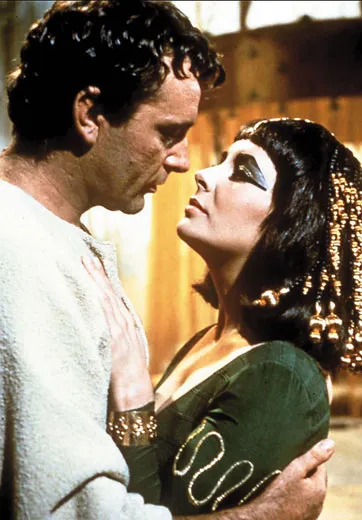
Cleopatra Seven ruled Egypt for 21 years a generation before the nascence of Christ. She lost her kingdom once; regained information technology; nearly lost it once again; amassed an empire; lost it all. A goddess as a child, a queen at 18, at the peak of her power she controlled virtually the entire eastern Mediterranean coast, the last great kingdom of whatsoever Egyptian ruler. For a fleeting moment she held the fate of the Western world in her hands. She had a child with a married man, three more with another. She died at 39. Catastrophe reliably cements a reputation, and Cleopatra's cease was sudden and sensational. In 1 of the busiest afterlives in history, she has become an asteroid, a video game, a cigarette, a slot machine, a strip guild, a synonym for Elizabeth Taylor. Shakespeare attested to Cleopatra'southward space variety. He had no idea.
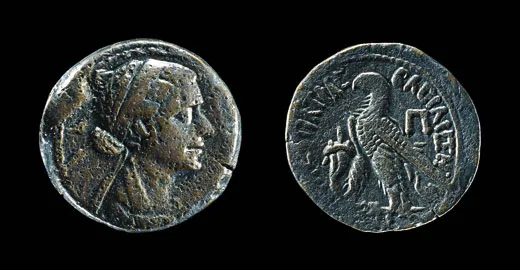
If the name is indelible, the image is blurry. She may be one of the most recognizable figures in history, just nosotros have little idea what Cleopatra actually looked like. But her money portraits—issued in her lifetime, and which she probable approved—can exist accepted as accurate. We remember her, too, for the incorrect reasons. A capable, articulate-eyed sovereign, she knew how to build a fleet, suppress an insurrection, control a currency. One of Mark Antony's most trusted generals vouched for her political acumen. Even at a time when female person rulers were no rarity, Cleopatra stood out, the sole woman of her world to rule alone. She was decidedly richer than anyone else in the Mediterranean. And she enjoyed greater prestige than every other woman of her time, equally an excitable rival rex was reminded when he called for her assassination during her stay at his courtroom. (The king's advisers demurred. In light of her stature, they reminded Herod, it could non be done.) Cleopatra descended from a long line of murderers and upheld the family tradition, just was for her time and place remarkably well behaved.
She nonetheless survives as a wanton temptress, not the kickoff fourth dimension a genuinely powerful woman has been transmuted into a shamelessly seductive one. She elicited contemptuousness and envy in equal and as distorting measure; her story is constructed as much of male fear as of fantasy. Her power was immediately misrepresented considering—for one man's historical purposes—she needed to take reduced another to apple-polishing slavery. Ultimately everyone from Michelangelo to Brecht got a crack at her. The Renaissance was obsessed with her, the Romantics even more than so.
Like all lives that lend themselves to poetry, Cleopatra's was 1 of dislocations and disappointments. She grew upwardly amid unsurpassed luxury and inherited a kingdom in refuse. For x generations her family, the Ptolemies, had styled themselves pharaohs. They were in fact Macedonian Greek, which makes Cleopatra near as Egyptian equally Elizabeth Taylor. She and her ten-yr-one-time brother assumed control of a land with a weighty by and a wobbly time to come. The pyramids, to which Cleopatra almost certainly introduced Julius Caesar, already sported graffiti. The Sphinx had undergone a major restoration—more than i,000 years earlier. And the glory of the once-great Ptolemaic empire had dimmed. Over the course of Cleopatra's childhood Rome extended its rule nearly to Egypt's borders. The implications for the concluding great kingdom in that sphere of influence were clear. Its ruler had no choice merely to courtroom the almost powerful Roman of the day—a bewildering assignment in the late Democracy, wracked as it was by ceremonious wars.
Cleopatra's begetter had thrown in his lot with Pompey the Great. Good fortune seemed eternally to shine on that brilliant Roman general, at least until Julius Caesar dealt him a crushing defeat in central Greece. Pompey fled to Egypt, where in 48 B.C. he was stabbed and decapitated. Twenty-one-year-old Cleopatra was at the time a avoiding in the Sinai—on the losing side of a ceremonious war against her brother and at the mercy of his troops and advisers. Quickly she managed to ingratiate herself with the new master of the Roman world.
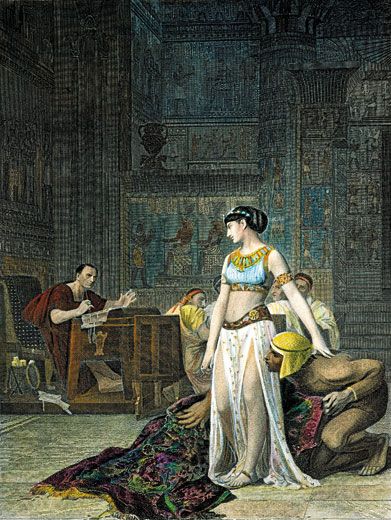
Julius Caesar arrived in Alexandria days after Pompey's murder. He barricaded himself in the Ptolemies' palace, the home from which Cleopatra had been exiled. From the desert she engineered a cloak-and-dagger return, skirting enemy lines and Roman barricades, arriving after dark inside a sturdy sack. Over the succeeding months she stood at Caesar's side—pregnant with his child—while he battled her brother'southward troops. With their defeat, Caesar restored her to the throne.
For the next xviii years Cleopatra governed the most fertile country in the Mediterranean, guiding it through plague and famine. Her tenure solitary speaks to her guile. She knew she could exist removed at any time past Rome, deposed by her subjects, undermined past her advisers—or stabbed, poisoned and dismembered by her own family. In possession of a first-rate education, she played to two constituencies: the Greek aristocracy, who initially viewed her with disfavor, and the native Egyptians, to whom she was a divinity and a pharaoh. She had her easily full. Non merely did she control an army and navy, negotiate with foreign powers and preside over temples, she likewise dispensed justice and regulated an economy. Like Isis, one of the most popular deities of the day, Cleopatra was seen every bit the beneficent guardian of her subjects. Her reign is notable for the absenteeism of revolts in the Egyptian countryside, quieter than it had been for a century and a one-half.
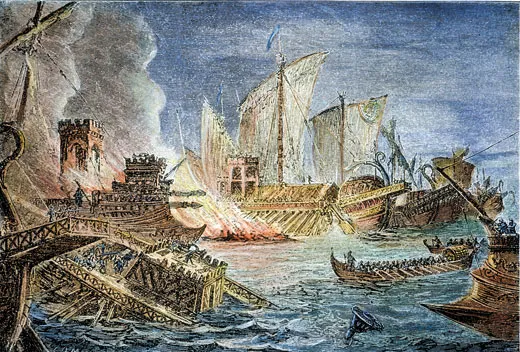
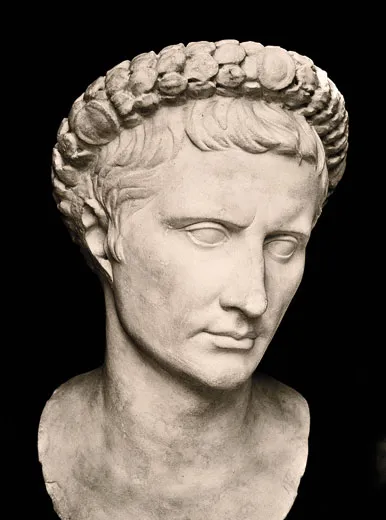
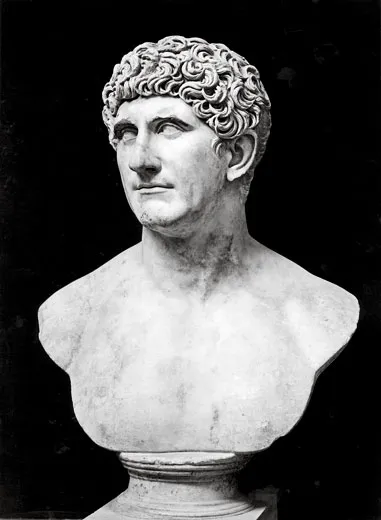
Meanwhile the Roman ceremonious wars raged on, equally tempers flared between Marking Antony, Caesar'south protégé, and Octavian, Caesar'south adopted son. Repeatedly the 2 men divided the Roman globe betwixt them. Cleopatra ultimately allied herself with Antony, with whom she had 3 children; together the two appeared to lay out plans for an eastern Roman empire. Antony and Octavian's fragile peace came to an end in 31 B.C., when Octavian alleged war—on Cleopatra. He knew Antony would non abandon the Egyptian queen. He knew too that a foreign menace would rouse a Roman public that had long lost its sense of taste for ceremonious war. The two sides ultimately faced off at Actium, a battle less impressive as a military engagement than for its political ramifications. Octavian prevailed. Cleopatra and Antony retreated to Alexandria. After prolonged negotiation, Antony's troops defected to Octavian.
A twelvemonth later Octavian marched an army to Egypt to extend his dominion, claim his spoils and transport the villain of the slice back to Rome, as a prisoner. Soundly defeated, Cleopatra could negotiate only the form of her surrender. She barricaded herself in a vast seaside mausoleum. The career that had begun with a brazen act of disobedience concluded with another; for the second time she slipped through a set of enemy fingers. Rather than deliver herself to Octavian, she committed suicide. Very likely she enlisted a gentle toxicant rather than an asp. Octavian was at one time disappointed and in awe of his enemy'due south "lofty spirit." Cleopatra'south was an honorable death, a dignified death, an exemplary death. She had presided over it herself, proud and unbroken to the stop. By the Roman definition she had at last done something right; finally it was to Cleopatra'southward credit that she had defied the expectations of her sex. With her death the Roman ceremonious wars came to an end. And so also did the Ptolemaic dynasty. In xxx B.C. Egypt became a province of Rome. It would non recover its autonomy until the 20th century A.D.
Can anything good be said of a adult female who slept with the two nearly powerful men of her time? Possibly, merely not in an historic period when Rome controlled the narrative. Cleopatra stood at one of the well-nigh dangerous intersections in history: that of women and power. Clever women, Euripides had warned 400 years earlier, were dangerous. Nosotros do not know whether Cleopatra loved either Antony or Caesar, only we do know that she got them to do her bidding. From the Roman indicate of view, she "enslaved" them both. Already it was a zero-sum game: a adult female's authorization spelled a homo's charade.
To a Roman, Cleopatra was thrice suspect, one time for hailing from a civilization known—as Cicero had information technology—for its "fribbling, fawning ways," again for her Alexandrian accost, lastly for her staggering wealth. A Roman could not pry apart the exotic and the erotic; Cleopatra was a stand-in for the occult, alchemical East, for her sinuous, sensuous country, equally perverse and original as its astonishment of a river. Men who came in contact with her seem to have lost their heads, or at least to take rethought their agendas. The siren call of the East long predated her, but no thing: she hailed from the exhilarant land of sexual practice and excess. It is not difficult to sympathise why Caesar became history, Cleopatra a legend.
Her story differs from nearly women'due south stories in that the men who shaped it enlarged rather than erased her part, for their own reasons. Her relationship with Antony was the longest of her life—the two were together for the better part of xi years—but her human relationship with Octavian proved the about indelible. He made much of his defeat of Antony and Cleopatra, delivering to Rome the tabloid version of an Egyptian queen, insatiable, treacherous, bloodthirsty, power-crazed. Octavian magnified Cleopatra to hyperbolic proportions to practise the aforementioned with his victory—and to smuggle Mark Antony, his real enemy and former brother-in-law, out of the picture.
Every bit Antony was erased from the record, Actium was wondrously transformed into a major engagement, a resounding victory, a historical turning point. Octavian had rescued Rome from neat peril. He had resolved the civil war; he had restored peace after 100 years of unrest. Time began anew. To read the official historians, it is as if with his render the Italian peninsula burst—after a crippling, cadaverous century of violence—into Technicolor, the crops sitting suddenly upright, crisp and plump, in the fields. "Validity was restored to the laws, authority to the courts, and nobility to the senate," proclaims the historian Velleius.
The years afterward Actium were a time of extravagant praise and lavish mythmaking. Cleopatra was particularly ill-served; the turncoats wrote the history. Her career coincided as well with a flowering of Latin literature. It was Cleopatra's curse to inspire its great poets, happy to expound on her shame, in a linguistic communication inhospitable to her. Horace celebrated her defeat before it had occurred. She helpfully illuminated one of the poet Propertius's favorite points: a man in love is a helpless homo, painfully subservient to his mistress. It was as if Octavian had delivered Rome from that sick every bit well. He restored the natural order of things. Men ruled women, and Rome ruled the world. On both counts Cleopatra was crucial to the story. She stands among the few losers whom history remembers, if for the wrong reasons. For the adjacent century, the Oriental influence and the emancipation of women would go on the satirists in business organisation.
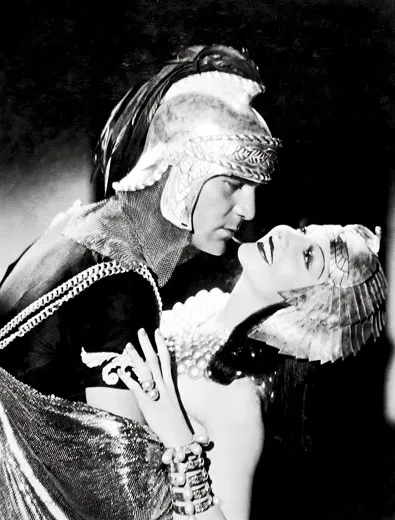
Propertius set the tone, dubbing Cleopatra "the whore queen." She would later become "a woman of clamorous sexuality and insatiable avarice" (Dio), "the whore of the eastern kings" (Boccaccio). She was a carnal sinner for Dante, for Dryden a affiche child for unlawful love. A first-century A.D. Roman would falsely assert that "ancient writers repeatedly speak of Cleopatra's insatiable libido." Florence Nightingale referred to her as "that disgusting Cleopatra." Offering Claudette Colbert the championship role in the 1934 movie, Cecile B. DeMille is said to have asked, "How would you like to be the wickedest woman in history?"
Inevitably diplomacy of state have fallen away, leaving us with affairs of the heart. We will remember that Cleopatra slept with Julius Caesar and Marking Antony long after nosotros think what she accomplished in doing so: that she sustained a vast, rich, densely populated empire in its troubled twilight. A commanding adult female versed in politics, diplomacy and governance, fluent in 9 languages, silver-tongued and charismatic, she has dissolved into a joint creation of the Roman propagandists and the Hollywood directors. She endures for having seduced two of the greatest men of her time, while her crime was in fact to have entered into the aforementioned partnerships that every human being in ability enjoyed. That she did and then in reverse and in her ain name made her deviant, socially disruptive, an unnatural adult female. She is left to put a vintage label on something we take always known existed: potent female sexuality.
It has forever been preferable to attribute a adult female's success to her dazzler rather than to her brains, to reduce her to the sum of her sex life. Against a powerful enchantress at that place is no contest. Against a adult female who ensnares a human in the coils of her serpentine intelligence—in her ropes of pearls—at that place should, at to the lowest degree, be some kind of antidote. Cleopatra would unsettle more every bit sage than as seductress; it is less threatening to believe her fatally attractive than fatally intelligent. Equally i of Caesar's murderers noted, "How much more than attention people pay to their fears than to their memories!"
A center of intellectual jousting and philosophical marathons, Alexandria remained a vital centre of the Mediterranean for a few centuries after Cleopatra's death. Then information technology began to dematerialize. With it went Egypt's unusual legal autonomy for women; the days of suing your father-in-law for the return of your dowry when your husband ran off with some other woman were over. After a 5th-century A.D. earthquake, Cleopatra's palace slid into the Mediterranean. Alexandria's magnificent lighthouse, library and museum are all gone. The urban center has sunk some 20 feet. Ptolemaic culture evaporated equally well; much of what Cleopatra knew would be neglected for 1,500 years. Even the Nile has inverse class. A very different kind of adult female, the Virgin Mary, would subsume Isis as entirely as Elizabeth Taylor has subsumed Cleopatra. Our fascination with the terminal queen of Arab republic of egypt has just increased every bit a result; she is all the more mythic for her disappearance. The holes in the story go along us coming back for more.
Adjusted from Cleopatra: A Biography, by Stacy Schiff. Copyright © 2010. With permission of Little, Chocolate-brown and Visitor. All rights reserved.
Stacy Schiff won the Pulitzer Prize for her 1999 biography, Véra (Mrs. Vladimir Nabokov): Portrait of a Marriage.
Easy Baby Drawings Step by Step Cleopatra as a Kid
Source: https://www.smithsonianmag.com/history/rehabilitating-cleopatra-70613486/
0 Response to "Easy Baby Drawings Step by Step Cleopatra as a Kid"
Post a Comment