Average Number of Family in One Bedroom Apartment
- In this Event
- Snapshot of Australia, 2016
- + Aboriginal and Torres Strait Islander Population Data Summary
- Aboriginal and Torres Strait islander Population Article
- Ageing Population
- Apartment Living
- Business Owner Managers Across Australia
- Cadre Action Need for Aid
- Cultural Diversity Data Summary
- Cultural Multifariousness Commodity
- Educational Qualifications Data Summary
- Employment Information Summary
- Population Shift: Agreement Internal Migration in Commonwealth of australia
- Religion Data Summary
- Religion Article
- Aforementioned-Sex Couples
- Sex and Gender Diversity in the 2016 Census
- Sexual practice and Gender Diversity: Characteristics of the Responding Population
- Small Towns
- Socio-Economic Advantage and Disadvantage
- Young Carers
- History of Changes
- Almost this Release

APARTMENT LIVING
INTRODUCTION
More Australians than ever are taking up apartment living, whether out of preference, convenience, or for other reasons. The 2016 Census of Population and Housing plant that x% (2,348,434) of all people in Australia spent Census dark in an apartment. At that place is now around one occupied apartment for every five occupied separate houses in Australia - compared with one to every vii, back in 1991. The growth in apartment living is primarily an urban phenomenon, concentrated within Commonwealth of australia'south major capital cities.
NUMBER OF OCCUPIED APARTMENTS
Over the past 25 years, the number of occupied apartments (including flats and units, excluding townhouses) in Commonwealth of australia has increased by 78% to 1,214,372 dwellings at the 2016 Census. There has been a steady increment in the number of apartments since 1991, although the Census shows slowing growth in the last five years. Near notably, the number of occupied apartments increased by 20% between 1991 and 1996, then past almost 17% between 2001 and 2006.
, 1991 - 2016.GIF)
Footnote(s): (a) Includes occupied flats, units and apartments. Source(s): ABS Census of Population and Housing, 1991 - 2016.
Comparing WITH OCCUPIED HOUSES
While the number of occupied apartments has increased over the last 25 years, the number of occupied separate houses has also continued to grow (from iv,533,595 in 1991 to 6,343,419 in 2016). There is now around 1 occupied apartment for every five occupied houses in Australia - compared with one for every 7 in 1991.
 1991 - 2016.GIF)
Footnote(s): (a) Apartments include flats and units. Dwelling counts refer to occupied individual dwellings merely. Source(due south): ABS Census of Population and Housing, 1991 - 2016.
HIGH-Ascent APARTMENTS
Apartments are associated with high-rise living. Indeed, Demography results confirm the rising prevalence of apartments in iv or more storey blocks. In 1996, near i in v (18%) of all Commonwealth of australia'south occupied apartments had this structural feature. By 2016 this had more than doubled to 38% of all occupied apartments (or 463,557 in number) inside four or more storey blocks.
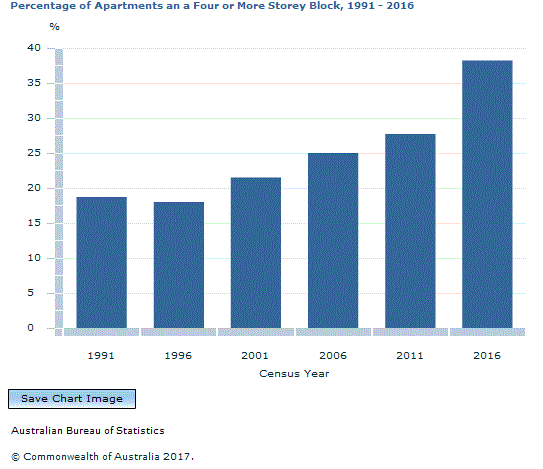
Source(south): ABS Demography of Population and Housing, 1991 - 2016.
WHERE ARE THE APARTMENTS?
States and Territories
Of the 1,214,372 occupied apartments in Australia in 2016, almost half (47%) were in New S Wales, followed by 23% in Victoria and 17% in Queensland.
New South Wales also had the highest proportion of apartments relative to all occupied private dwellings (at 21%). The Northern Territory was also prominent with 17% of its occupied private dwellings existence apartments.
APARTMENTS: PERCENTAGE DISTRIBUTION BY STATE AND TERRITORY(a), 2016
| | ||
| Country/Territory | As % of all apartments in Australia | As % of all occupied private dwellings in state/territory |
| | ||
| New Due south Wales | 47.ii | 20.7 |
| Victoria | 22.viii | 12.3 |
| Queensland | 17.4 | 11.8 |
| South Australia | 3.8 | 6.8 |
| Western Commonwealth of australia | 4.7 | half-dozen.1 |
| Tasmania | 1.0 | half-dozen.0 |
| Northern Territory | 1.1 | 17.0 |
| Australian Capital Territory | 2.0 | xvi.0 |
| | ||
 | | |
| Australia(b) | 100.0 | thirteen.7 |
| (a) Includes flats and apartments. Occupied private dwellings only. (b) Includes details for the Other Territories. Source: ABS Census of Population and Housing, 2016. | ||
Capital Cities
Apartments were more often than not located in the capital city regions. Three capital cities contained over 90% of all occupied apartments in their Country. They were Melbourne (94%), Perth (92%) and Adelaide (91%). The flat share was more equal in Queensland, with Brisbane having 52% of Queensland'due south full.
, 2016.GIF)
Footnote(due south): (a) Greater Majuscule City Regions, ASGS. The Act is treated as 1 region; hence there is no capital city/residue of territory dissever. Source(s): ABS Census of Population and Housing, 2016.
PEOPLE IN APARTMENTS
In 2016, almost 10% (2,348,434) of people in Australia spent Census nighttime in an apartment. Most (95%) were at their usual flat home. There were likewise 128,520 visitors staying in apartments, with forty.3% from overseas and the remainder visiting from elsewhere in Australia.
Over one-half (51%) of all people in Commonwealth of australia's apartments on Census night, 2016, were counted in New Southward Wales. This was more double the 22% share recorded in Victoria.
New South Wales besides had the most apartment visitors - at 51% of the national count.
Including visitors, the boilerplate number of people counted per apartment on Census night was 1.9.
In comparison, the boilerplate number of people counted in separate houses was 2.eight.
PERSONS COUNTED IN APARTMENTS BY STATE AND TERRITORY, 2016(a)
| | ||
| Country/Territory | At their usual home | Total - including visitors(b) |
| | ||
| New S Wales | 1,138,736 | 1,196,187 |
| Victoria | 475,993 | 506,444 |
| Queensland | 356,233 | 381,099 |
| South Australia | 73,309 | 77,237 |
| Western Australia | 91,359 | 97,456 |
| Tasmania | 18,615 | 19,701 |
| Northern Territory | 25,751 | 27,878 |
| Australian Capital Territory | 39,599 | 42,061 |
| | ||
| Australia(c) | 2,219,924 | 2,348,434 |
| | ||
(a) Place of enumeration. Includes visitors from overseas or elsewhere in Australia - who were present in apartments on Census nighttime.
(b) Includes details for the Other Territories.
Source: ABS Census of Population and Housing, 2016.
AGE AND Sex
Within the apartment dweller population
In 2016, 29% of all apartment residents (excluding visitors) in Australia were in the 25-34 historic period group. Another xi% were children aged 0-14 years, upward slightly from the 10% share recorded a decade before.
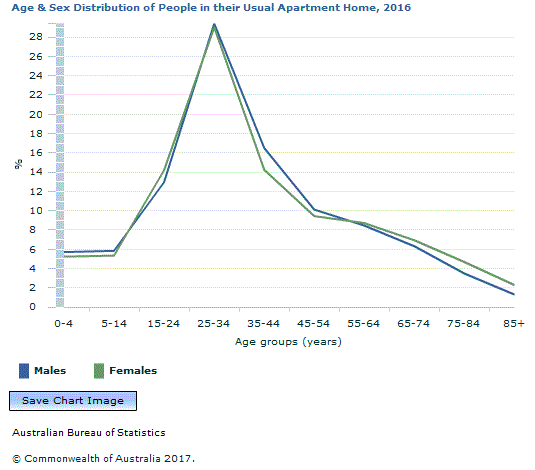
Source(s): ABS Census of Population and Housing, 2016.
The median age of males and females who usually lived in an apartment was the same (33 years). This was much lower than the medians recorded for all males and females in Australia (37 and 38 years respectively).
People living in apartments were more than likely to be female than male (51% compared with 49%) - mirroring the proportions observed for the overall population at the 2016 Census. Females were also slightly more likely to be living in apartments in their later on years than males, perhaps reflecting longer female person life expectancy and different lifestyle and accommodation preferences.
Compared with the overall population living in individual dwellings
In 2016, 1 in five (21%) of all people aged 25-34 years (and living in private dwellings) were apartment residents. Nearly i in viii (12%) of all persons aged 85 years or more than - and 35-44 years - were also apartment residents.
Younger people were also quite prominent. More than one in ten (11%) of Australia'due south youth population (aged fifteen-24 years) resided in apartments. Similarly, virtually one in ten (ix%) of all children aged 0-four years had an apartment habitation.
 per Age Group, Living in Apartment Homes, 2016.GIF)
Footnote(due south): (a) Total population counted in occupied private dwellings. Source(southward): ABS Census of Population and Housing, 2016.
REGIONAL DISTRIBUTION OF Apartment DWELLERS
In 2016, 85% of Australia'southward apartment dwellers (excluding visitors) lived in capital city regions, with other concentrations mostly found along the eastern coast. This distribution is shown by this map of Australia's Statistical Expanse Level four (SA4) regions with capital city insets.
PEOPLE IN THEIR APARTMENT Abode, SA4 REGIONS
OF Commonwealth of australia, 2016
At the smaller Statistical Expanse Level 2 (SA2) geography, Melbourne SA2 (situated in the inner urban center) had the most flat dwellers in Australia with 37,916 people, 88% of whom were counted at their usual dwelling house - with the rest beingness visitors from overseas or elsewhere in Australia. 2d ranked was Waterloo - Beaconsfield, just 5 km from the Sydney CBD, with 27,541 flat dwellers. One time semi-industrial, this region has experienced new residential development, particularly in Beaconsfield, thus transforming the nature of the region. Also in Australia's top five were Sydney - Haymarket - The Rocks, Parramatta - Rosehill and Perth Metropolis.
Melbourne was also notable in having 4,420 temporary visitors in its apartments on 2016 Demography night, with 69% originating from overseas. None of the other 'superlative three' SA2 regions across Australia matched these visitor levels.
Not all prominent apartment regions were in the inner capital city areas. Regions such as Surfers Paradise, Mermaid Beach - Broadbeach, Glenelg, Nightcliff and Sandy Bay suggest a second view - that apartment living can as well exist embankment-side living.
PERSONS COUNTED IN APARTMENTS - TOP THREE SA2 REGIONS IN EACH Country AND TERRITORY, 2016(a)
| | ||
| Statistical Expanse Level ii Regions | At their usual flat dwelling | Full counted(b) |
| | ||
| New Southward Wales | | |
| Waterloo-Beaconsfield | 26,079 | 27,541 |
| Sydney-Haymarket-The Rocks | 23,765 | 26,355 |
| Parramatta-Rosehill | 23,046 | 24,294 |
| | ||
| Victoria | | |
| Melbourne | 33,496 | 37,916 |
| St Kilda | 17,650 | xviii,614 |
| Southbank | 16,899 | 18,540 |
| | ||
| Queensland | | |
| Surfers Paradise | 16,215 | 17,772 |
| Newstead-Bowen Hills | 8,427 | eight,905 |
| Mermaid Beach-Broadbeach | eight,129 | 8,781 |
| | ||
| South Australia | | |
| Adelaide | seven,036 | vii,721 |
| Glenelg | 3,799 | 4,009 |
| Goodwood-Millswood | 3,338 | 3,484 |
| | ||
| Western Commonwealth of australia | | |
| Perth City | 20,955 | 22,755 |
| Wembley-West Leederville-Glendalough | 4,733 | 4,967 |
| Subiaco-Shenton Park | iii,902 | iv,136 |
| | ||
| Tasmania | | |
| Hobart | 2,435 | ii,648 |
| Sandy Bay | 1,422 | i,523 |
| Glenorchy | ane,152 | 1,214 |
| | ||
| Northern Territory | | |
| Darwin City | 5,170 | five,722 |
| Larrakeyah | 1,831 | two,046 |
| Nightcliff | 1,869 | 2,021 |
| | ||
| Australian Uppercase Territory | | |
| Belconnen | 3,647 | iii,860 |
| Braddon | three,426 | 3,690 |
| Kingston | 3,411 | 3,641 |
| | ||
(a) Identify of enumeration. (b) Includes visitors from overseas or elsewhere in Australia who were nowadays in apartments on Census night.
Source: ABS Census of Population and Housing, 2016.
Country OF BIRTH
In 2016, more than than 4 in every 10 (44%) apartment residents were built-in in Australia. Around one in x (11%) were born in North - Eastern asia (which includes China and Hong Kong) and Southern and Cardinal Asia, which includes India (9%).
From another perspective - and highlighting the multi-cultural nature of apartment living - simply 6.7% of all Australian born people (who live in private dwellings) were living in apartments on Demography night, 2016. This compares with 17% of all the overseas built-in population.
Over 31% of all people born in North-Eastern asia - and in Australia on Demography night - were living in flat homes. There were also college proportions of people born in Southern and Central Asia (26%) and the Americas (24%) counted in their apartment homes.
PERSONS COUNTED AT THEIR USUAL Flat HOME BY COUNTRY OF BIRTH, Australia, 2016
| | ||
| Land of birth | % of all persons in apartments | % of persons by State of nascence who live in apartments |
| | ||
| Australia (including the External Territories) | 44.two | half dozen.7 |
| Oceania and Antarctica (excluding Australia) | 3.0 | 10.9 |
| North-West Europe | vi.two | x.four |
| Southern and Eastern Europe | 3.2 | xi.7 |
| Due north Africa and the Centre E | two.8 | 17.five |
| South-Due east Asia | half-dozen.five | 17.four |
| North-East asia | 10.6 | 31.3 |
| Southern and Central Asia | nine.0 | 26.iii |
| Americas | two.8 | 24.iii |
| Sub Saharan Africa | 1.seven | 12.6 |
| Other | 0.i | 21.5 |
| Not stated | 9.7 | 16.1 |
| | ||
| Total(a)(b) | 100.0 | x.2 |
| | ||
(a) Please note that there are modest random adjustments made to all jail cell values to protect the confidentiality of data. These adjustments may crusade the sum of rows or columns to differ by pocket-sized amounts from table totals.
(b) Place of enumeration.
Source: ABS Census of Population and Housing, 2016.
HOUSEHOLDS AND FAMILIES
In 2016, the most prevalent type of household living in apartments in 2016 were one family unit households at 48% - up from 45% in 2011. The proportion of group households also rose, up from viii.7% in 2011 to 9.6% in 2016.
Families with children were as well well represented in the flat living population. At the 2016 Census, families with children (and either one or two parents) comprised almost 44% of all families living in apartments in Australia.
The proportion of solitary person households living in apartments has declined, down from 46% in 2011 to 42% in 2016.
 Living in Apartments, Australia, 2011 and 2016.GIF)
Footnote(due south): (a) Excludes visitor only households and other non-classifiable households. Ii or more family unit households have been excluded; they comprised less than ane% of households in apartments in 2011 and 2016. Source(due south): ABS Census of Population and Housing, 2011 and 2016.
TENURE IN APARTMENTS
The 2016 Demography showed that tenure for all apartments across Australia was:13% owned outright, 15% owned with a mortgage and well over one-half (59%) being rented. In contrast, 34% of separate houses were endemic outright, 38% owned with a mortgage, and 21% rented.
Both Queensland and New Due south Wales were prominent in having almost 14% of occupied apartments owned outright. In contrast, the ACT had the 2d everyman proportion of apartments endemic outright (8%) just the highest proportion of mortgaged apartments (19%).
In all states and territories, the majority of apartments were rented. The highest proportions were in Tasmania, the Northern Territory and Southward Australia where around ii-thirds were rented (or 66%, 64% and 63% respectively).
 by State and Territory, 2016.GIF)
Footnote(southward): (a) Tenure type 'not stated' included in the calculation of percentages. (b) Includes apartments purchased under a shared equity scheme. (c) Includes apartments with free rental. Source(s): ABS Census of Population and Housing, 2016.
INCOME AND HOUSING PAYMENTS
Household income
In 2016, the
median full income for apartment households was $1,280 a week, considerably lower than the median of $1,526 recorded past households living in separate houses. This may reflect in office the younger historic period profile of flat dwellers, and the lower average number of people living in apartments (compared with separate houses).
The highest full income medians were recorded past flat households in the Northern Territory ($1,862 per week) and Australian Capital letter Territory ($ane,669). These were more than than double the corresponding medians for apartment households in Tasmania ($687) and South Commonwealth of australia ($803).
Hire and mortgage payments
Rent charges can be determined by the location, size and condition of the dwelling house. Also, Commonwealth of australia's apartments are more often than not situated in central, urban areas. Such factors tin influence the corporeality of hire being paid by apartment households. In 2016, rent or mortgage payments were more expensive for people living in apartments than for those living in separate houses.
For apartment households in Australia, in 2016, the median weekly rent payment was $365 - higher than the corresponding median for renters of separate houses ($330). A smaller deviation ($295 compared with $280) was observed in 2011.
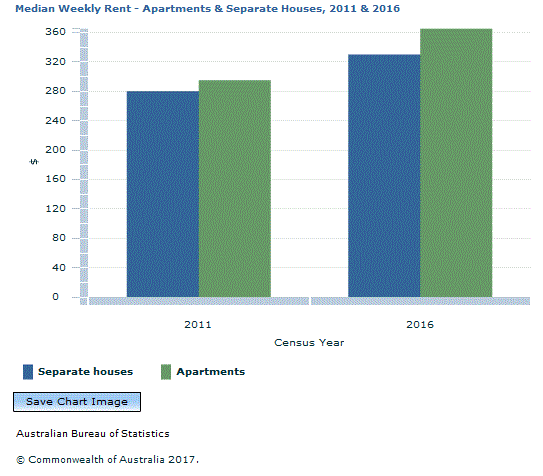
Source(s): ABS Census of Population and Housing, 2011 and 2016.
In 2016, the median monthly mortgage repayment for apartment households was $1,830, again higher than the $1,733 median for split up houses.
Households renting an apartment were four times as probable to pay xxx% or more of their weekly income on rent than renters of split houses: at 28% compared with 7.three%. In contrast, iv.five% of households with mortgaged apartments spent 30% or more of their monthly income on mortgage payments - compared with 8.1% of households with mortgaged separate houses.
HOUSING SUITABILITY
Housing suitability compares the number of bedrooms in a dwelling with a range of household demographics, such as the number of usual residents, their age and sexual activity.
Using criteria developed by the Canadian National Occupancy Standard, it tin can identify if an flat is either nether-utilised (with spare bedrooms) or over-utilised (needing extra bedrooms).
In 2016, it was more likely that households living in apartments did non require an actress sleeping room, or had none spare, than those living in separate houses (42% compared with 13%). They were also more probable to have one spare bedroom (38% compared with 29%).
 and Houses - Their Suitability for Usually Resident Households(b), 2016.GIF)
Footnote(s): (a) Includes occupied flats, units and apartments. (b) Excludes visitor simply and not-classifiable households that were enumerated in apartments. Source(s): ABS Demography of Population and Housing, 2016.
Regional details
While the need for extra rooms can be an result for regions with seasonal employment or transient educatee populations in detail, it is negligible nationally. Merely three,711 (or 0.3%) of all apartments in Australia needed three or more than extra bedrooms, on Census night, 2016.
The bulk of over-utilised apartments (2,596, or 70%) were located in New S Wales. More specifically, within the inner city SA2s of Sydney-Haymarket-The Rocks (with 408 apartments requiring three or more than actress bedrooms), Pyrmont-Ultimo (149 apartments in need), Auburn-N (146) and Strathfield (109).
Interstate, Melbourne was prominent - with 191 apartments needing 3 or more than extra bedrooms to suitably business firm their occupants.
MOTOR VEHICLES
In 2016, most half (47%) of households living in apartments had one registered motor vehicle - garaged, parked on-site or near their home. The 'two automobile' lifestyle was maintained by only sixteen% of apartment households. In dissimilarity, only 28% of households in carve up houses had i vehicle, increasing to 39% for two vehicles.
 or Separate House, Percentage Distribution(b) - Australia, 2016.GIF)
Footnote(s): (a) Includes occupied flats, units and apartments. (b) Number of vehicles 'not stated' included in the adding of percentages. Source(s): ABS Demography of Population and Housing, 2016.
Most 21% of Australia's flat households reported having no motor vehicle. This may reverberate the inner city location of some apartments - and their shut proximity to work, public transport and amenities. Victoria was particularly notable, with a quarter (25%) of its apartment households being without a vehicle.
Regional details
The following SA2 regions had the about apartment households without a motor vehicle: Melbourne (12,357); Sydney-Haymarket-The Rocks (five,134); Carlton (4,960); Potts Indicate-Woolloomooloo (4,388); Waterloo-Beaconsfield (three,721); Redfern-Chippendale (3,690); and Southbank (iii,018).
On the flip side, just 3.ane% of apartment dwellings in Australia 'hosted' three or more motor vehicles. This may reflect (in part) the limited garaging space within some apartment complexes. The post-obit SA2 regions had 300 or more apartments hosting three or more motor vehicles: Double Bay-Bellevue Colina (327 apartments); Surfers Paradise (320); Cronulla-Kurnell-Bundeena (313); Wollongong East (308); and Coogee-Clovelly (300).
EXPLANATORY Data
i All information are presented on a Identify of Enumeration ground.
2 The dwellings data in this commodity pertain to occupied private dwellings merely. Unoccupied, vacant or not-private dwellings are excluded from the statistics.
three Flats and units are included in the concept of apartments used in this article. These dwellings do not have their own individual grounds and unremarkably share a common archway foyer or stairwell. They tin can range from ane storey to multi storey dwelling structures. Flats attached to houses are also counted as apartments.
4 Townhouses, as well as semi-discrete row/terrace houses and separate houses, are regarded equally distinct dwelling structures and excluded from the apartment concept. More details are available in the 2016 Census Dictionary.
five Circumspection is needed when comparing home structure information. Changes to Census nomenclature methods between 2011 and 2016 may have afflicted data comparability.
Average Number of Family in One Bedroom Apartment
Source: https://www.abs.gov.au/ausstats/abs@.nsf/Lookup/by%20Subject/2071.0~2016~Main%20Features~Apartment%20Living~20
0 Response to "Average Number of Family in One Bedroom Apartment"
Post a Comment